
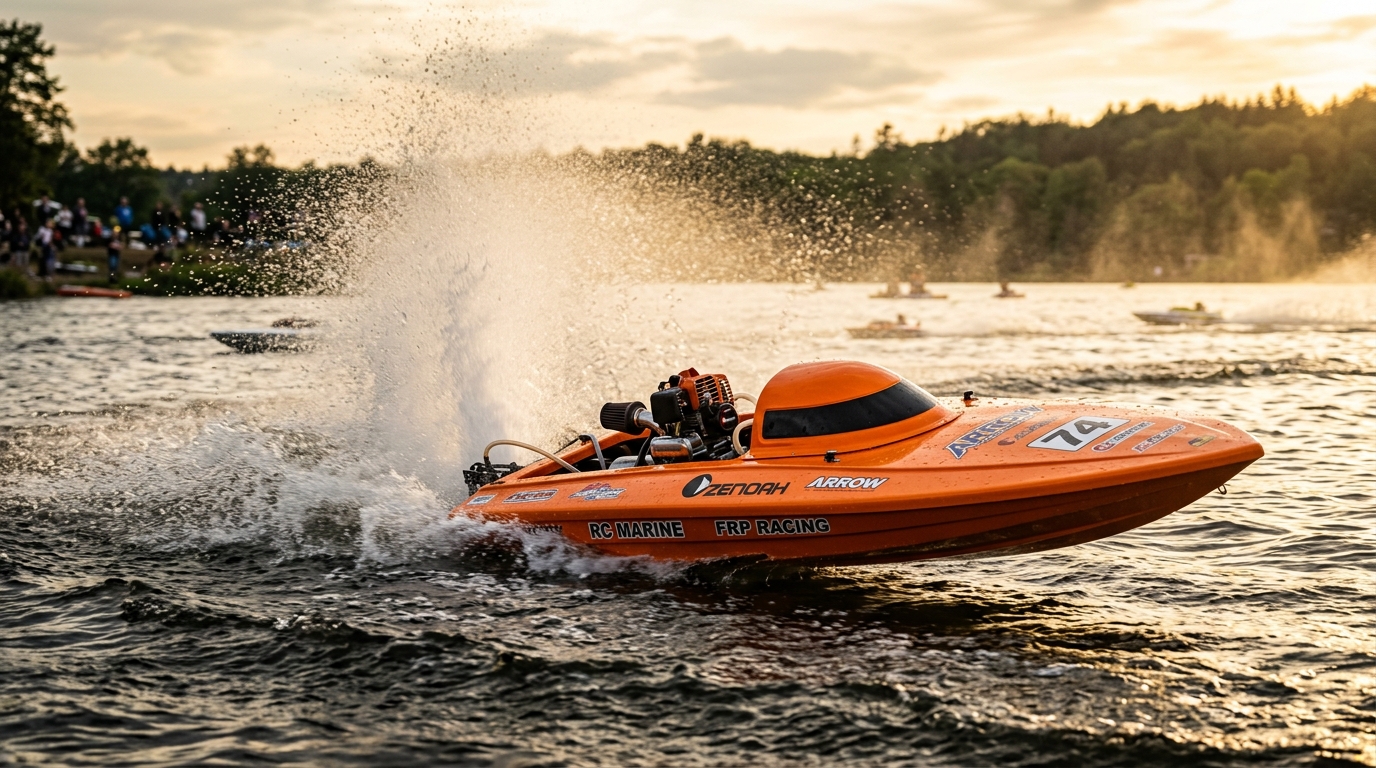

The Orange Enforcer Super G Complete RTR is the boat that started it all for Enforcer RC Boats — a hand-laid fiberglass hull paired with a Zenoah G230RC air-cooled engine and Enforcer clutch, ready to run straight out of the box. Simple to start, genuinely fast, and built to handle aggressive water conditions, the Super G is one of the most satisfying gas RC boats you can put on the water.
But getting the most out of it takes more than unboxing. Here’s your complete how-to guide for setting up, tuning, and running your Orange Enforcer Super G like a pro.
???? Grab the Orange Enforcer Super G RTR here — in stock and ready to ship.
Step 1: Break In the Zenoah G230RC Engine
The G230RC is a proven 2-stroke air-cooled powerplant, but it needs a proper break-in before you push it hard. Skip this and you risk premature wear — do it right and you’ll get years of reliable performance.
- Mix your fuel at approximately 5 oz of quality synthetic 2-stroke oil per gallon of 92-octane pump gas
- Run the first 4–6 tanks at no more than half throttle, alternating between idle and mid-range RPM
- Gradually increase run time at higher throttle as the break-in progresses — by tank 6, you’re ready to tune for full power
- Keep an eye on engine temperature during break-in — air-cooled engines need adequate water flow time between runs
Step 2: Carburetor Tuning (Walbro HSN/LSN)
The G230RC runs a Walbro carburetor with two adjustable needles — the High Speed Needle (HSN) and Low Speed Needle (LSN). Getting these dialed in is the single biggest factor in engine performance.
Starting point: Set both needles to 1.5–2 turns open from fully closed. This gives you a safe, rich starting position.
Tuning the HSN:
- Warm up the engine fully, then make several wide-open throttle passes on the water
- If the engine gurgles, bogs, or smokes heavily — it’s running rich. Turn HSN clockwise ⅛ turn at a time
- If it hesitates, cuts out at top end, or sounds strained — it’s lean. Turn HSN counter-clockwise ⅛ turn
- Best check: pull the spark plug after a full-throttle run. Tan tip = perfect. Black = too rich. White/gray = dangerously lean
Tuning the LSN: Only touch this after the HSN is set. Adjust for crisp throttle response from idle to mid-range. If the engine lags coming off idle, richen the LSN slightly. If it four-strokes (misfires) when backing down from full throttle, lean it a touch.
Step 3: Hull Trim and Propeller Selection
The Super G’s 46-inch fiberglass hull is fast and stable by design, but trim setup makes a real difference in top speed and handling.
- Propeller: The stock prop is a solid starting point, but testing an Octura prop can unlock more top-end speed. The only way to find your ideal prop is to test — run, record speed, swap, repeat
- Trim tabs: These small adjustable plates at the transom correct prop walk (the boat pulling left or right due to prop torque). Adjust in small increments — too much trim creates drag. If the boat porpoises at speed, dial back the trim slightly
- CG and engine mounting: Ensure the engine is mounted securely and level. A high engine mount raises the center of gravity and affects the prop shaft angle — keep it as low as practical
Step 4: Radio Setup and Failsafe
Before your first water run, configure your radio properly:
- Set your failsafe to neutral throttle and centered steering — if you lose signal, the boat idles rather than running wide open
- Configure a kill switch on your transmitter — essential for stopping a runaway boat quickly
- Tune your steering EPA (End Point Adjustment) so the rudder doesn’t over-travel and cause snap-spins at speed
- Check that all linkages move freely with no binding
Step 5: On-Water Running Tips
- First runs: Start slow. Check steering response, throttle feel, and radio trims before pushing speed
- Turns: The Super G turns precisely but can spin out if you’re too aggressive mid-turn while accelerating. Smooth throttle out of turns is faster than abrupt inputs
- Maintenance after every session: Check and re-torque exhaust bolts (use blue Loctite 242 — vibration loosens them fast), rinse the hull, and inspect the prop for nicks or dings
- Tuned pipe tip: If you upgrade to a liquid-jacketed tuned exhaust, dial in pipe length by shortening 3–6mm at a time and testing after each change — stop when speed drops
Ready to Run — Literally
The Orange Enforcer Super G earns its RTR label — it genuinely is ready to run from the moment it arrives. But with proper break-in, a dialed-in Walbro carb, the right prop, and solid trim setup, you’ll transform a great out-of-the-box boat into a truly exceptional one.
Questions about setup? Drop them in the comments — we read every one. And if you’re ready to get yours on the water, order the Orange Enforcer Super G RTR directly from our store — in stock and shipping now.