

The Prop Is Your Final Drive Ratio
Everything upstream of the prop — engine, pipe, carb, clutch — is hardware. The prop is where all of that energy hits the water. Get it wrong and you are wasting every horsepower you built. Get it right and your boat runs like it was designed to. Prop selection is not a secondary consideration. It is the setup.
Pitch: The Number That Changes Everything
Pitch is the theoretical distance the prop travels forward in one revolution. Higher pitch moves more water per turn. Lower pitch lets the engine rev faster and accelerate harder out of the hole. Neither is universally better. The right pitch depends on your engine displacement, hull weight, and the RPM range where your pipe and carb make peak power.
If your engine is lugging and temperatures are climbing, your pitch is too high. Back it down. If the engine screams to the rev limiter and hits a wall at top end, your pitch is too low — add pitch and load the motor into its powerband. That is the feedback loop. Listen to it.
Diameter Matters Too
Most racers focus on pitch and ignore diameter. That is a mistake. Diameter affects how much water the prop bites on each revolution. A larger diameter prop grips harder but demands more torque. Smaller diameter reduces drag and lets the engine rev more freely. On a lightweight tunnel hull running a high-revving 26cc engine, a smaller, higher-pitch prop is often faster than a big-diameter unit. Context matters. Your hull and engine combination dictate the window.
Start with the prop spec recommended for your hull and engine combination. Then move pitch in half-turn increments. Record your GPS top speed and your peak RPM after every change. Data beats guessing every single time.
Three-Blade vs. Two-Blade
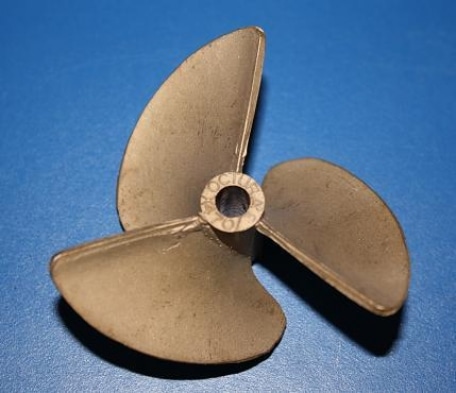
Two-blade props dominate straightline speed on the water. Three-blade props add grip and acceleration, especially in rough water or on heavier hulls. For most gas-powered tunnel and catamaran setups, a quality two-blade prop running at the right pitch is the fastest option. Three-blade props shine when traction and predictability matter more than absolute top end — think rough-water racing or boats with torquey low-RPM engines.
Inspect Every Session
A nicked or bent prop blade does not just bleed speed. It creates vibration that works through your flex cable, strut, and hull. One rock strike can cost you the whole drivetrain if the damage goes unnoticed. Before every run, spin the prop by hand. Look for blade edge damage, cracks at the hub, and any wobble in rotation. Five seconds of inspection before you launch beats a blown cable halfway through a heat.
Carry a spare prop to every session. Always. A prop change takes two minutes. A DNF lasts all day.
Match the Prop to the Track
Flat, glassy water rewards a bigger, higher-pitch prop. Rough or choppy water rewards something that stays loaded through the chop. Know your venue. If you are racing a lake with afternoon chop, a prop that is perfect at noon may cavitate badly by 3 PM. Experienced racers carry two or three options and read conditions before they pick their setup for the day.
Ready to Run Harder?
Enforcer RC Boats stocks performance propellers for gas-powered and electric competition hulls. Get the right pitch for your setup at enforcerrcboats.com or call us at 317-844-4695. Stop leaving speed in the prop box.