
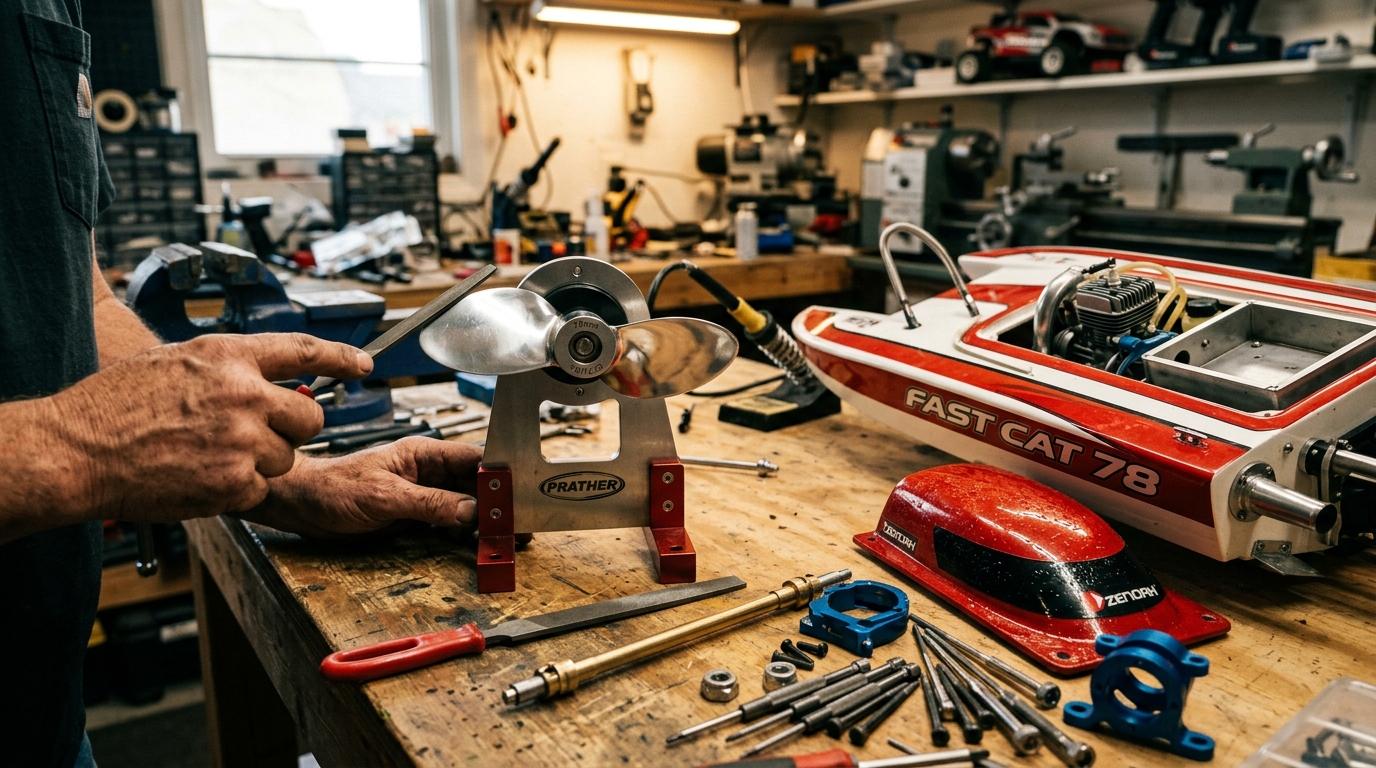

If you run gas RC boats long enough, you learn that propellers are not just finishing parts. They are decision-making tools.
That is exactly why the 78MM 2 Blade Aluminum Prop deserves more respect than it usually gets. Enforcer recommends it as a great break-in prop, and it comes with many of the brand’s ready-to-run boats for a reason. It is affordable, easy to prep, easy to balance, and strong enough to give you useful information about what the boat wants before you jump to more expensive brass or stainless hardware.
If you set it up properly, this prop can help you build a cleaner baseline, reduce wasted testing, and avoid blaming the wrong part when your boat is not happy.
Start with the right expectations
This prop is a 78mm 2 blade aluminum design with a 1/4-inch bore for a 1/4-inch drive shaft. That makes it a natural fit for many gas sport and performance boats using common Enforcer-style driveline hardware.
The key thing to understand is this: this is not a prop you buy because it is flashy. You buy it because it is useful. Aluminum props like this are excellent for break-in, early setup work, and practical day-to-day testing because they cost far less than premium race props and still tell you a lot about hull attitude, driveline smoothness, and engine load.
That means your goal is not heroic prop surgery. Your goal is a clean, reliable, honest prop that helps you learn something every run.
Step 1: Inspect the prop before it ever touches the shaft
Before mounting it, inspect the hub and both blades carefully. Look for casting burrs, rough edges, visible nicks from shipping, or anything that could keep the prop from seating cleanly on the drive hardware.
Make sure the 1/4-inch bore fits your shaft and drive dog correctly. If the prop does not seat flat and true, the rest of your setup work becomes guesswork. A slight fit problem at the hub can feel like driveline vibration, engine roughness, or handling instability on the water.
This is also the time to confirm that the rest of your driveline is worth testing. A good prop will not fix a bent shaft, worn collet, loose hardware, or bad cable alignment.
Step 2: Balance it before you run it
One of the biggest advantages of this Enforcer aluminum prop is that balancing is fast and simple. The product description is right about that. With a magnetic balancer and a small flat file, you can usually get it sorted in minutes.
Mount the prop on the balancer and let the heavy side fall naturally. Remove only a tiny amount of material at a time from the heavy blade, then check again. Stay patient. You are chasing smoothness, not grinding for drama.
A properly balanced prop reduces vibration, helps the driveline live longer, and gives you more trustworthy feedback during break-in and tuning. That matters because an unbalanced prop can fool you into thinking the engine tune is off, the hardware is loose, or the hull setup is wrong when the real problem is sitting at the back of the boat.
Step 3: Sharpen the edges, but do not thin the blades
This is where people get carried away.
Enforcer’s own guidance is solid: do not thin this prop. Because it is an aluminum die-cast prop, over-thinning hurts blade integrity. Instead, simply sharpen the blade edges to a dull but sharp finish. That is the sweet spot.
Use a flat file or light finishing method to clean the leading edges and remove roughness. You want the prop to cut cleanly through the water, not turn into a fragile experiment. A sensible edge prep gives you cleaner running without sacrificing the prop’s durability.
For a break-in or test prop, consistency matters more than aggression. If you go too far, you can weaken the blade and lose the very reliability that makes this prop worth owning.
Step 4: Use it to build a baseline, not just to “get by”
A lot of boaters throw on a break-in prop and mentally dismiss the results. That is a mistake.
Use this prop to establish your baseline for launch behavior, throttle response, engine loading, cooling consistency, and overall hull attitude. Does the boat come on pipe cleanly? Does it carry the bow the way you expect? Does it stay planted in turns? Does the engine feel overloaded, lazy, or happy?
Because the 78MM 2 Blade Aluminum Prop is affordable and predictable, it is a smart reference point. If the boat has problems here, solve those before spending money on fancier hardware. If the boat runs cleanly here, then you have earned the right to test more aggressive prop options with confidence.
Step 5: Watch for the real warning signs on the water
When you test, pay attention to more than speed. Watch for cavitation, excessive vibration, poor launch, strange steering pull, rising engine temp, or a boat that feels unsettled at speed. Those signs may point to setup issues, but they can also tell you the prop is damaged, out of balance, or simply not the right match for the rest of the package.
This is also why it helps to log your runs. Water conditions, fuel, needle settings, and prop changes all interact. The more disciplined your notes are, the faster you will separate prop behavior from engine behavior.
Final tip: keep one in the box even after you upgrade
Even if you move on to higher-end props for all-out performance, keep this prop in your pit box. It is still useful for troubleshooting, fresh-engine break-in, backup testing, and getting a boat back on the water when you do not want to risk expensive hardware.
That makes it more than an entry-level part. It makes it a smart long-term tool.
The 78MM 2 Blade Aluminum Prop is not exciting because it is exotic. It is exciting because it is practical, honest, and useful, which is exactly what good RC boat setup parts should be.
If you have been treating your break-in prop like an afterthought, this is a good time to stop. Prep it right, learn from it, and let it make the rest of your setup decisions easier.