

Your Prop Is Not Just a Fan
Most guys treat the propeller as an afterthought. They bolt on whatever came in the box and wonder why their Zenoah-powered boat feels lazy out of the hole or falls flat at the top end. The propeller is the only part of your boat that converts engine torque into thrust. Think of it as your gearbox. If you are running the wrong diameter or pitch, you are either lugging the engine or letting it over-rev without moving water. Selecting the right prop is the single most effective way to tune your boat’s performance without opening the engine case.
Diameter and Pitch: The Fundamentals
Diameter is the total width of the blade sweep. A larger diameter prop moves more water and provides more thrust, but it also adds significant load to the engine. If your Zenoah is struggling to reach its powerband, your diameter might be too large. Pitch is the theoretical distance the prop moves forward in one revolution. Higher pitch means more top speed, but slower acceleration. Lower pitch gives you that snap out of the turns but will limit your top-end mph. For most Enforcer hulls running a stock Zenoah, a 78mm 2-blade aluminum prop is the baseline. It’s balanced, reliable, and gives the engine enough room to breathe during break-in and sport running.
Tuning the Pitch for Peak RPM
To get the most out of your setup, you need to match the prop to your engine’s peak RPM. If you are running a stock Zenoah G260 or G290, you want a prop that allows the engine to reach its target operating range under load. If you swap to a higher pitch prop and your RPMs drop significantly, you’ve gone too far. You are trading torque for speed that the engine can’t actually maintain. Conversely, if the engine is screaming but the boat isn’t gaining speed, you are cavitating or under-propped. Make small changes. A few millimeters of diameter or a slight shift in pitch makes a massive difference on the water. Balance and sharpen your metal props to reduce vibration and drag. A dull, unbalanced prop is just a vibration generator that kills your drive bearings.
Three Blades vs. Two
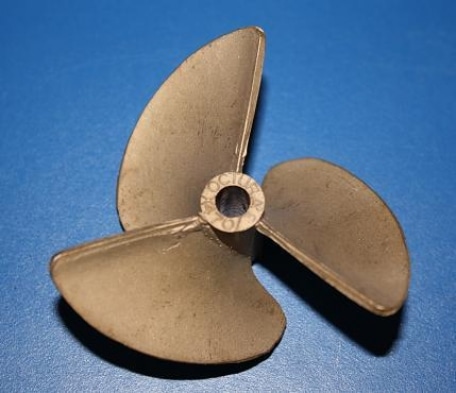
The debate between two-blade and three-blade props comes down to your hull and your goals. Two-blade props are generally more efficient for pure top speed because they have less surface area drag. They are the standard for most mono hulls. Three-blade props offer better ‘grip’ and smoother acceleration. If your boat tends to slide in the corners or you are running a heavy offshore style hull, a three-blade prop can help keep the boat hooked up. However, the extra blade adds load. If you move from a two-blade to a three-blade of the same diameter, you will likely need to drop the pitch to keep the engine from overheating. Tune for the conditions, not just the numbers.
Ready to Run Harder?
Enforcer stocks a full range of performance propellers, from our standard aluminum break-in props to high-speed stainless and beryllium copper options. Check the propeller section at enforcerrcboats.com or call us at 317-844-4695 to discuss which prop matches your engine and hull. We’ve been prop-tuning gas boats since 1983 and we still answer the phone.