
The Prop Is the Final Link in Your Power Chain
You can build a Zenoah that screams and a hull that tracks like a laser. None of it matters if the prop on the back of your boat is wrong. Pitch, diameter, blade count, and finish — every one of these decides how much of that engine’s power actually pushes water. Get it wrong and you’ll bog, blow out, or leave half your speed on the trailer. Get it right and the boat comes alive.
Pitch Versus Diameter — Know What You Are Trading
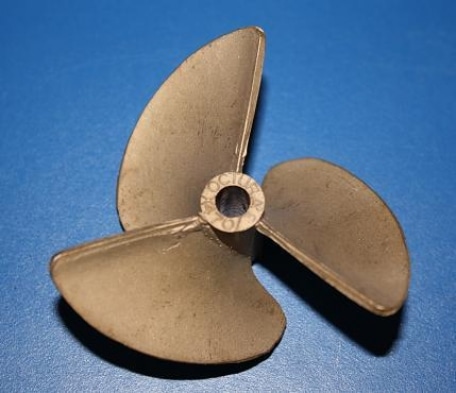
Diameter is the size of the disc the blades sweep through. More diameter moves more water and builds thrust. Pitch is how far the prop would theoretically travel in one revolution if it were a screw through a solid. More pitch trades acceleration for top-end speed. A high-pitch prop with a small engine loads it down and kills RPM. A low-pitch prop on a strong Zenoah lets the engine over-rev and burn fuel without going faster. The art is matching prop load to the powerband where your engine and pipe make peak power.
Start with What Your Hull Wants
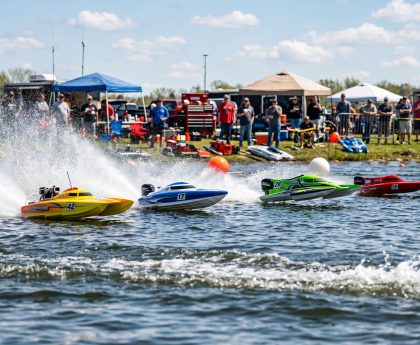
Mono hulls and offshore boats generally like a larger-diameter, medium-pitch three-blade prop because they need bite to stay planted in chop. Catamarans and tunnel hulls run cleaner with smaller-diameter, higher-pitch two-blade props that let the sponsons carry the boat and the prop just punch a hole through clean water. Hydros like our Stingray Hydro thrive on small-diameter, high-pitch props because the boat is barely touching the surface — you don’t need bite, you need to convert RPM into forward motion with the least drag possible. If you don’t know where to start, call us. We’ve been propping these hulls since 1983 and we’ll save you a stack of guesswork.
Balance, Sharpen, and Test
A prop straight out of the package is rarely race-ready. Put it on a prop balancer before it ever touches your boat — an unbalanced prop hammers your strut, cable, and seals every revolution. Sharpen the leading edge and round the trailing edge with a fine stone. Polish the back side of the blade. Tiny finishing work shows up as real miles per hour. After every run, check for nicks, blow-out edges, and bent blades. A dinged prop is a slow prop.
Ready to Run Harder?
The catalog at enforcerrcboats.com is stocked with the props, balancers, and finishing tools that have been winning races for over four decades. Not sure which pitch fits your setup? Call us at 317-844-4695. We still answer the phone — and we’ll get you matched to the right prop the first time.