
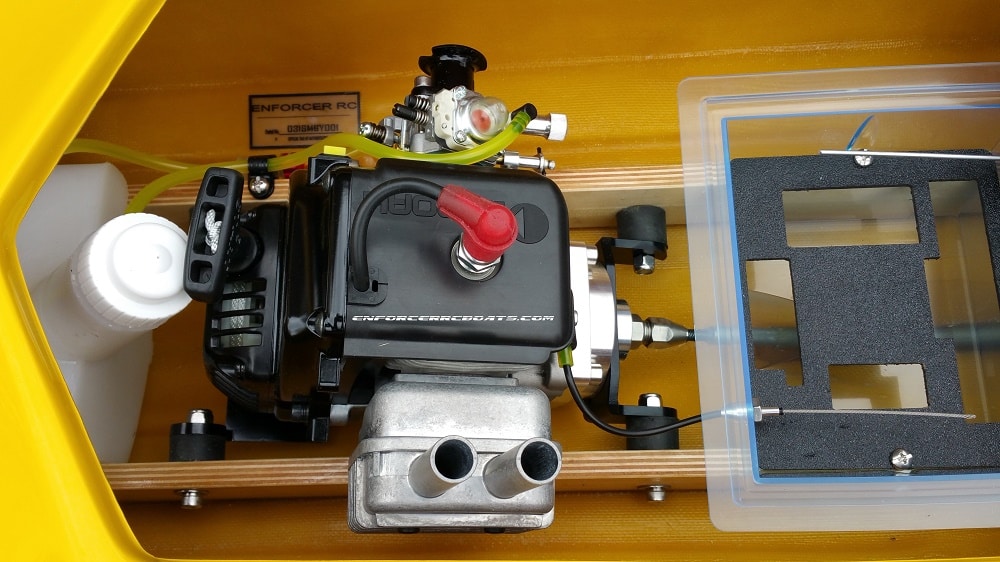

Heat Is the Enemy — Don’t Let It Win
Gas RC boats run hot. That’s not a bug — it’s physics. A Zenoah pulling full throttle on a warm summer afternoon generates serious heat, and if your water-cooling system isn’t dialed in, you’ll be limping back to the dock with a seized engine before the first heat is over. Proper cooling setup isn’t optional. It’s survival gear for your powerplant.
Setting Up Your Cooling Circuit
Start with the pickup. The water inlet needs to sit in the boat’s slipstream — submerged and positioned to scoop clean, pressurized water at speed. Too far back and you’re pulling turbulent water. Too far forward and the fitting creates drag. Most setups run a transom-mounted or hull-mounted pickup tubed directly into the head cooling jacket. The outlet exits above the waterline, typically through the transom or a side port. Use reinforced silicone tubing throughout — standard vinyl kinks under heat and pressure and will fail you at the worst possible moment. Every barb fitting gets a proper clamp, no exceptions.
Flow Rate: How Much Is Enough?
You want enough flow to keep the head cool without flooding the exhaust or dropping cylinder temps so far that the engine loses efficiency. On a standard Zenoah G260 or G290, look for a slight trickle from the outlet at idle that builds to a steady stream at mid-throttle. Some setups run an inline flow control valve to regulate volume — useful on boats with larger pickups that push too much water at speed. No thermostat needed in most RC applications since flow is already self-regulated by boat speed. If you have an infrared thermometer, check the head after a few hard passes. Target is roughly 150–180°F. Hotter than that, tighten up your cooling circuit. Cooler is generally fine unless you’re fighting rich jetting.
Troubleshooting: No Flow, Low Flow, Overheating
If you’re seeing heat-related symptoms — hard starting after a few laps, a slow lean seizure creeping up on you, or a head that’s too hot to touch — work through the system in order. First, pull the pickup and check for debris. A single weed or dock slime can block the inlet completely. Second, inspect every tube connection. One loose barb fitting bleeds enough air into the circuit to kill flow. Third, check the head fitting and cooling jacket passage — if it’s carboned up or partially blocked, water can’t do its job regardless of how clean the rest of the system is. Finally, if flow looks solid but you’re still overheating, look at your carburetor needle position. Overheating is often a symptom of running lean, not just a cooling failure. Don’t replace hardware before you’ve ruled out a simple needle adjustment.
Ready to Run Harder?
Enforcer stocks cooling fittings, reinforced silicone tubing, and water-cooling hardware built for gas RC boat applications. Whether you’re building up a new hull or replacing worn components on a boat that’s seen a few seasons, our team can help you spec the right setup for your engine and hull combination. Browse the shop at enforcerrcboats.com or call us at 317-844-4695 — we still answer the phone.