
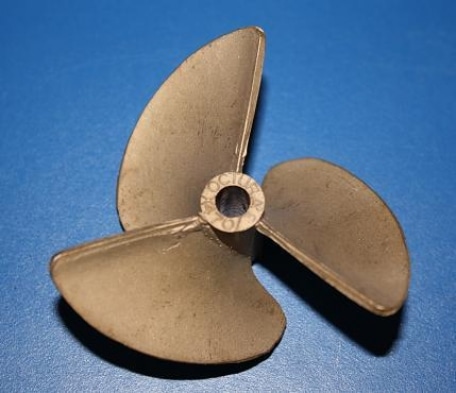

The Prop Is Your Final Drive Ratio
You can tune a perfect carb, nail your break-in, and fit a matched tuned pipe — then throw it all away with the wrong prop. The propeller is the last mechanical link between your engine and the water. It determines your top speed, your acceleration, and whether you’re working inside your engine’s power band or fighting against it. Getting prop selection right isn’t luck. It’s math and testing, with a bit of feel thrown in once you’re running.
Pitch: What It Means, What It Does
Pitch is the distance a prop would travel in one complete revolution through a solid medium — think of it like the thread pitch on a bolt. A 50mm pitch prop theoretically advances 50mm per revolution. High pitch equals higher top-end speed but demands more torque and RPM to stay in the pull. Too much pitch and your engine bogs, RPM drops below peak power, and you’re slower than you would be with a smaller prop. Too little pitch and you’re spinning the engine past its power band with nothing to show for it. The goal is to find the pitch that lets the engine hit its WOT RPM target while actually loading the hull correctly for the water conditions you’re running.
Diameter, Blade Count, and Real-World Variables
Pitch gets the attention, but diameter matters too. Larger diameter moves more water per revolution but adds drag and load. For most sport gas mono and hydro applications, you’ll be working in a relatively defined diameter range for your class or hull size. Blade count changes the character of the prop: a 2-blade typically delivers higher top-end speed with less drag; a 3-blade gives better mid-range grip and acceleration, which can matter in choppy water or tight courses. When you’re dialing in, start with the manufacturer’s recommended pitch range for your engine displacement and hull type, then test in one-step increments. A half-pitch change makes a measurable difference. Don’t jump two sizes and try to interpret mixed results.
Balancing the Prop Before It Goes in the Water
A brand-new prop that’s even slightly out of balance will introduce vibration that works backward through the entire drive system — into the flex shaft, the strut, the motor mount, and the hull. A prop balancer is cheap insurance and a five-minute job on the bench. Get one, use it every time. If your prop takes a hit and survives intact, rebalance it before you run again. A bent blade that looks fine can be noticeably out of balance. On a gas boat running 10,000+ RPM, that imbalance multiplies fast.
Ready to Run Harder?
Enforcer stocks a full range of RC boat propellers and prop balancers matched to Zenoah-powered hulls of all types. Not sure which pitch to start with for your setup? Call the team at 317-844-4695 — we’ve been matching props to engines and hulls since 1983. Browse the full prop selection at enforcerrcboats.com.